Molly Lasker: November 2025
Molly Lasker is a PhD candidate at the University of Tasmania who is researching Tuvalu's metaverse digitisation process as a climate change adaptation strategy and its potential implications on the colonisation of intangible cultural heritage due to the external control of cultural data. Her research attempts to investigate the role of spectral infrastructures in this development and how legacies of colonial rule and weapons testing in the Pacific have culminated in the development of a digital twin in Tuvalu alongside other in-situ adaptation measures. Her research synthesises Plumwood's critiques of anthropocentrism and the human/nature binary with Tuvaluan fenua ontologies.
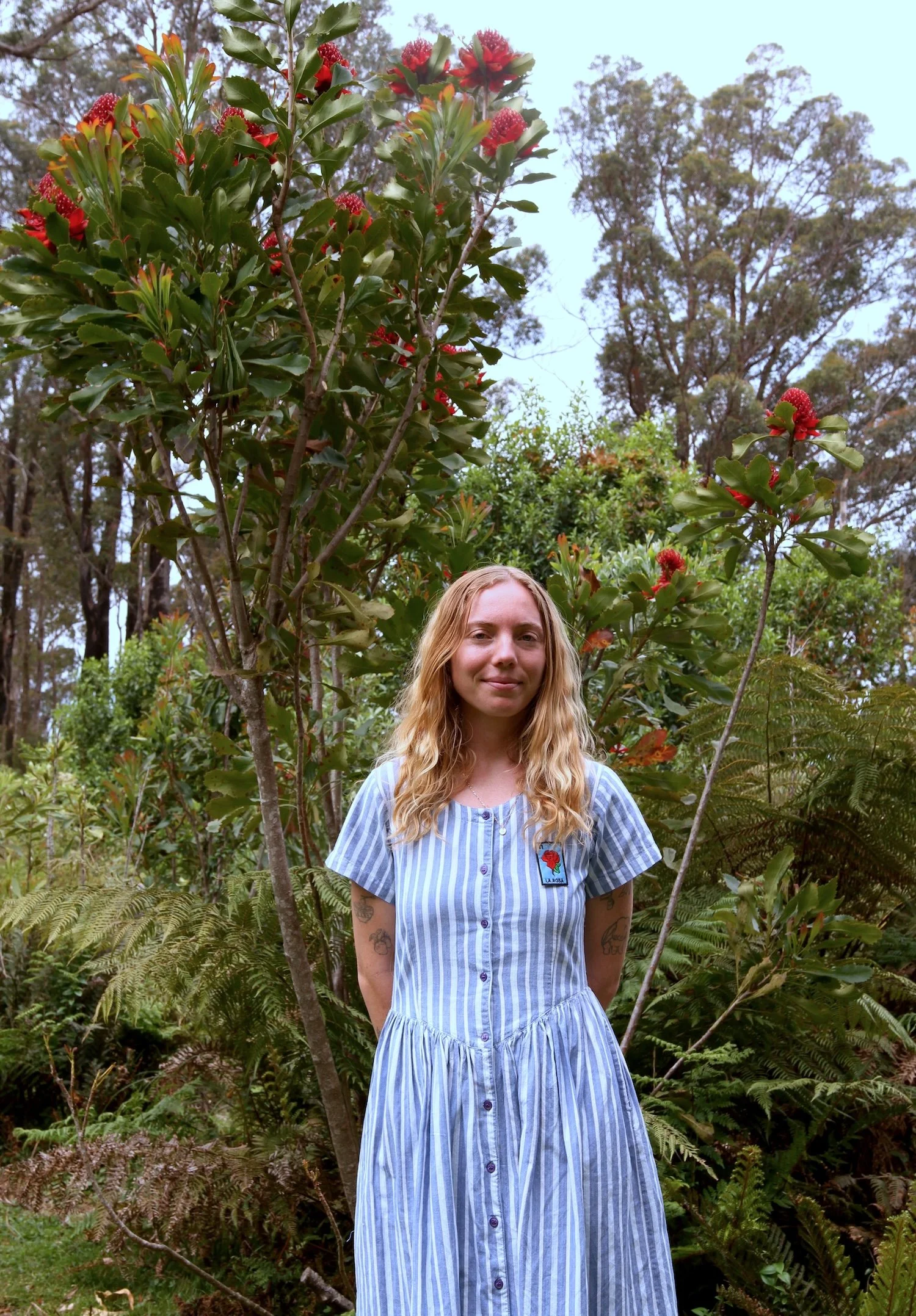
Molly Lasker in front of a flowering waratah (photo credit: Morgan Jones, 2025).
Molly visited Plumwood Mountain in November 2025, working on the project: Discrete Subversion: Spectral Infrastructure, Climate Change and Sovereignty in a Digital Tuvalu.
Molly writes:
I felt really grateful to be held and supported by the Mountain and Val's spirit during my time on Walbunja country. I was overwhelmed and humbled by how little attention her spirit commanded; even in her death her commitment to situate herself within the complex web of life was inspiring.
I spent most of my time thinking and reflecting on legacies; Val's legacy, the legacy of words and of spirits, and the colonial legacies that permeate through the different infrastructures that maintain our lives. I also read a lot about islands and was inspired by Val's piece on shadow places to think about islands using this idea, particularly islands in the Pacific. My PhD research attempts to understand the Pacific Island nation of Tuvalu's digital twin and the contradictions between the colonial legacies and Pasifika cosmologies involved in its development. Val's shadow place idea fits strongly within this narrative; as strategic nodes in the production of the Anthropocene, the lands and waters of the Pacific bear the scars of colonial extraction, nuclear colonialism and environmental degradation.
Plumwood Mountain felt, to me, like a kind of sky island; the diversity in the landscape was accompanied by a sense of insularity and boundedness. But like Pacific Islands, which are connected by virtue of the water that surrounds them, I could sense that Plumwood Mountain does not exist in isolation but is part of a broader network of care and reciprocity. I hope to one day give back to the Mountain just as it gave to me.
Thanks for visiting Molly, and good luck with your PhD!