Le-Anne Bannan is a researcher in GIS and environmental geography based in Narrm (Melbourne). Her primary goal and motivation in her research is to find applications of geospatial science that support sustainable progress toward social and environmental justice. Le-Anne visited Plumwood in July 2026, to continue work on the Keeping Place project, which centres the perspectives of Marralam Community and amplifies Indigenous aspirations for environmental management in northern Australia, troubling the binary between native/invasive species on Gajerrong Country. Find out more about the Keeping Place project, or connect with Le-Anne via her LinkedIn.
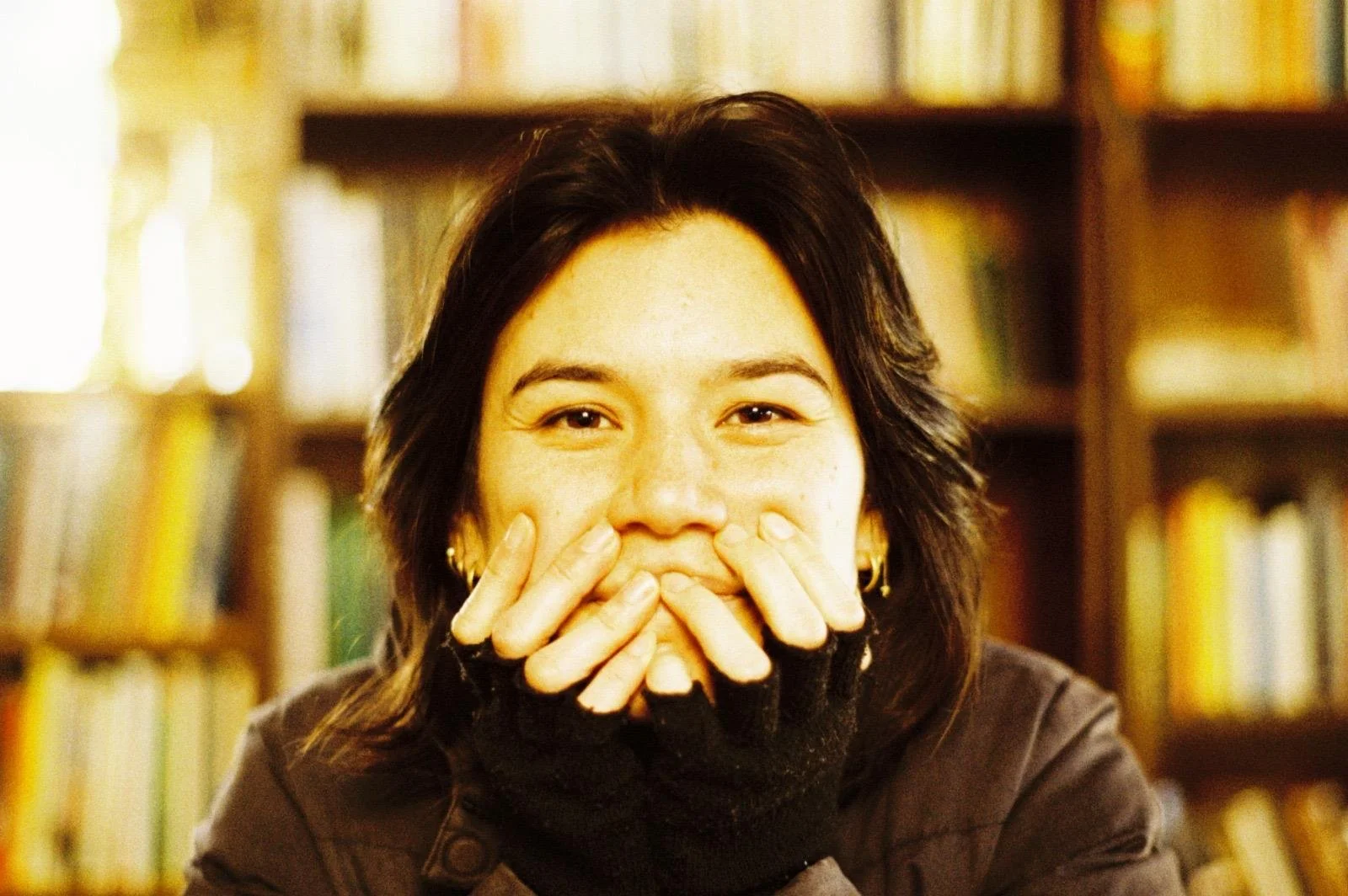
Le-Anne Bannon, Plumwood Mountain, 2026.
reciprocity : 27-07-2026
by Le-Anne Bannan
i sat on a mountain,
feeling my body ease into
a gentle rhythm that has been playing
for longer than i could ever understandthe slow hum,
the steady rise,
the fall and the peaks
of the bird calls throughout the dayi came here exhausted,
pulled in every direction.
daughter, friend, partner,
writer, worker, self.it is hard to know who you are
when no one is calling your name.
it is easy to forget
that there is no difference between you
and the lyrebird
that has been recording the secrets of the forest
for fifteen million years.i let my body relax,
free from the eyes and the expectations,
knowing that these trees are indifferent
to who i was yesterday,
who i might be tomorrow,
worried, only about how i will receive their gifts
and in which ways i understand ‘recoprocity’but what of those whose gifts that brought me here?
how can i hold your daughter’s hand while i am so far away?
who will help her cross the street?
where does my mother call while I am tending to these plants,
who never asked me for my help.i grew up tending
to the red, raw wrists of domesticity,
afraid that reciprocity only meant responsibility,
until you told me it was not mine to carry.
in communities,
they grow whether we are watching or not.
our agreement is irrespective of proximity.perhaps one day,
i will wake up and know
that there is nothing further to be done,
or that can be done,except to watch the sun rise,
the flowers as her witness,
over the same ridge
that she blows a gentle kiss to
at the end of each day.but for now,
i see that this breath is only temporary.
a task to be shared.a moment of rest,
afforded to me by everything that you do,
so that i may return
with the gifts of this place –the steady rise,
and the fall and the peaks
of the bird calls throughout the day.
and share them with you
while we try to understand
in which ways we might live in ‘reciprocity’
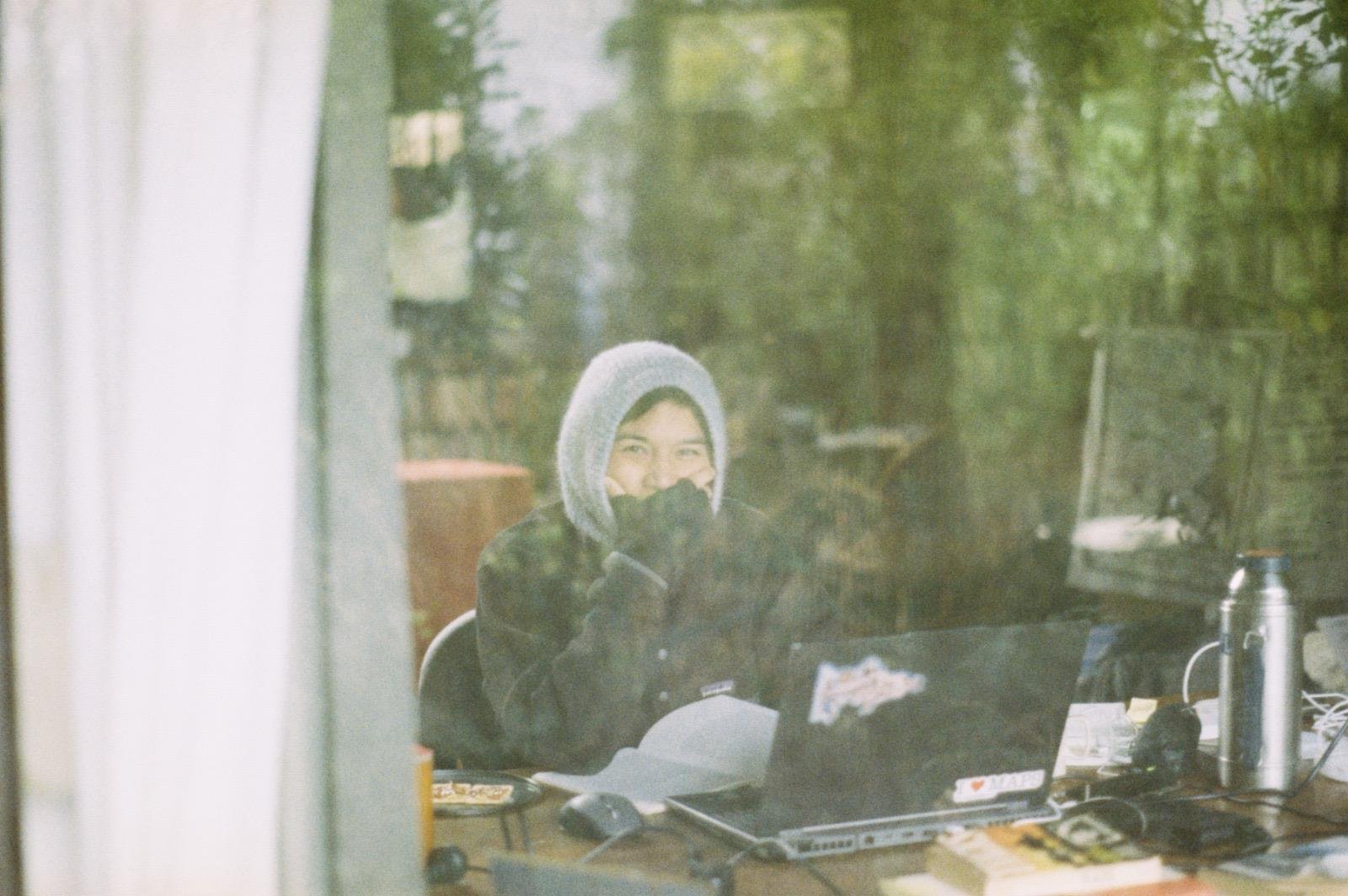
Le-Anne writing at Val’s desk during her residency, having never been one for cold weather (photo courtesy of Le-Anne Bannon, 2026).
Camelias on the Balcony: A reflection on eco-feminism, inner-city apartments and Plumwood Mountain
By Le-Anne Bannan
As I sat on my balcony, looking out at Narrm (Melbourne), now, a grey and concrete city, I was surprised to find my mind drifting back to this reflection that had been sat, stubbornly unwritten, for the past three months. The time it had taken me to complete this task was starting to evolve into a deep sense of guilt. I had not been able to produce the small piece of writing that had been asked in exchange for the opportunity to stay at Plumwood Mountain as part of their residency program.
The trouble, I’d decided, was that I had written my first draft on my final day at Plumwood and was now too far away from it. My inspiration for this first draft was a particularly beautiful sunrise, over a densely canopied valley, I had the pleasure of witnessing at Val’s lookout spot. I clearly remember the joy and inspiration that I felt sitting on a wrought-iron garden seat, almost the exact same as the one on this balcony. But every time I re-opened the document to revise my writing since leaving, Plumwood felt further away and so did the reflections that were so resonant on that morning.
I remember driving away from the mountain with a sense of confidence and conviction. Three weeks on the mountain, one week completely on my own. I felt that I had learned so much about independence, reciprocity and the difficult work of eco-feminism that Val had dedicated her life to. I was determined to hold on to it as tightly as I could. But, as I returned to Narrm, I also found myself being swept up in the thrum of a busy city. The dependable rhythm of lyrebirds, trees, wombats and wallabies felt worlds away. The anxieties from the city had already crept back into my body, my mind and my work. A stark difference to how I felt during my residency.
On the mountain, eco-feminism feels intuitive. You wake up, one small part of a much wider, wiser and reliable process of time, geology and evolution. You make your small contributions to give thanks for their seemingly endless gifts and the gifts of all others who stewarded for this space before you. Your contributions might be clearing the thick branches that have come down over night. You might chop them and stack them carefully for a fire one day in the future. This fire might be for you, or the mountain’s next visitor. You are almost always rewarded immediately, with unimaginable beauty, as you look up and your eyes adjust to the endless, small, white sassafras flowers that blanket the ground.
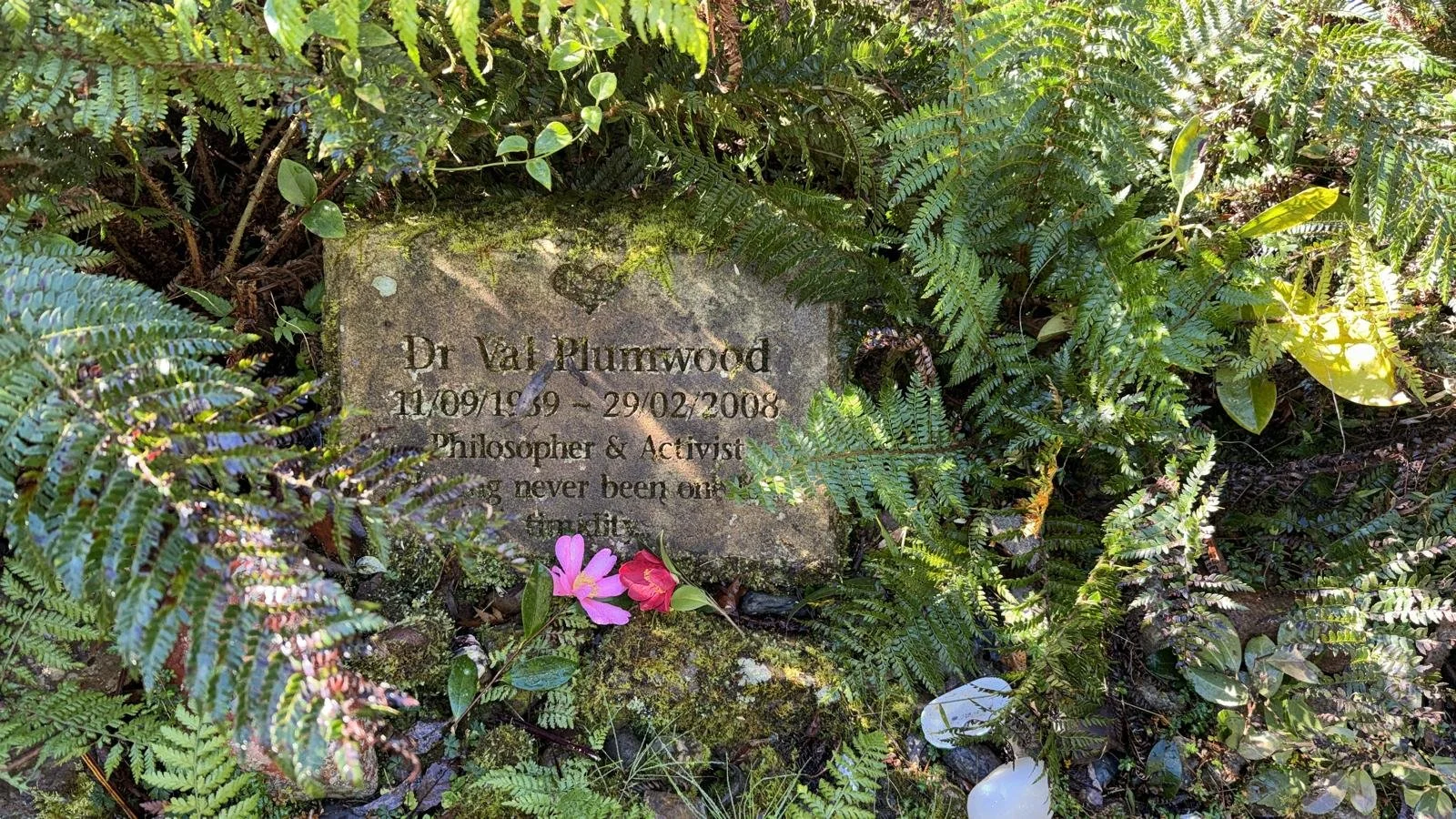
Val Plumwood’s gravestone which reads ‘Dr Val Plumwood, 11/09/1939-29/02/2008, Philosopher & Activist, Having never been one for timidity’ with two flowers from her beloved garden (photo courtesy of Le-Anne Bannon, 2026).
You might contribute by clearing the leaves from Val’s grave. In return, the mountain might provide you strength and confidence, to tackle whatever task you have brought with you, through the inscription of feminine courage that was thoughtfully memorialised by her friends. Every encounter on the mountain holds stories and knowledge that sparks endless inspiration for philosophy, research, creativity and writing. In the city, though, attention and action are commodities.
Time moves faster here. Eco-feminism feels further. The trees seem decorative rather than instructive. You adjust and re-adjust from the disorientation of trying to navigate through the maze of the city, each building imperceptible from the last. The same layout, the same fixtures. You pay for care. You are paid for care, or often, not. The same tinny alarm clock rings. Again and again.
In the city, we negotiate time for space, perpetually realising we have the balance wrong. We negotiate again and again. Gardens are removed from schedules to allow more time for financialised work. Green spaces are forfeited to claim back time otherwise spent commuting. We learn to live very close to each other, but rarely intersect except in an elevator, or at a red light. We are always in transit, anxiously tapping, trying to get ahead of the tick of our clocks. Despite this optimisation, clever scheduling, technology, there is nowhere in the world that feels more rushed, timeless or stressed than a busy city like Narrm.
I am certain that I am not the only person who wonders, how can anyone participate in eco-feminism here? A place where patriarchy feels embedded in every structure. A harsh grid imposed on a gentle Country, stewarded for thousands of years by Wurundjeri Woi Wurrung peoples. The tall, phallic, buildings made from materials that were ripped from the earth. The Birrarung, soothing the wound of a waterfall detonated by explosives, all the while it itself is choked and channelled by concrete. The women in my life, frustrated at the unrelenting systems that run our lives. Val herself said many of these things were what lead her to her mountain.
For those of us who stay, I wondered why and how we agree to abide by rules that are so incompatible with the life-giving processes of care, nature and rest? What respect should we have for systems that leave those of us who attempt to navigate it with integrity and feminist care exhausted and physically isolated? As I considered my own frustrations among all of this, and my to-do list for the day, I realised, hopelessly, again, that there was not enough time to complete all of the work that was waiting for me. Including this reflection, that felt impossible in such a setting. I looked away from the skyline and into my neighbour’s balcony.
For the first time, I noticed their bonsai trees. A camelia and an azalea. Transported, watered and maintained in two ceramic pots by the elderly woman who lives next door. I affectionately known her as bà, the Vietnamese word for grandmother. I think about how she spends her days cooking for her granddaughter, whose education this family had moved to Australia for. A country which neither the granddaughter’s parents nor her grandparents were familiar with, but which they all hoped would bring opportunities that were not available to them. Opportunities that they were all willing to sacrifice their own time and comforts to try to bring closer.
I thought about these small trees on the balcony and compared them to the camelias and the flowers in Val’s gardens. I considered the reprieve that they brought for these women in the apartment next door. I recognised the cultivation of these bonsai trees as an effort to bring care and beauty into an often hostile and patriarchal environment. The same care and beauty I believe that Val had cultivated on her mountain, which it now exudes so freely. I remembered the two seedlings on my windowsill.
Waratahs seedlings that had sprouted from a seed pod that my partner brought back from Plumwood mountain. He, too, determined to cultivate a piece of such a special place. This important work, in our own lives in Melbourne. These two sets of plants, on this balcony and on my windowsill, both efforts of determined individuals to ground a lineage of wisdom and carry it into new environments. A visible reminder that even here, there is still opportunity for intention, care and stewardship of the life-giving processes that nurture us. The pillars of what I understand eco-feminism to be. Ready to be cultivated in every corner of our lives, as long as we nurture them.
I looked out at the city with this new perspective and noticed the trees dotting the streetscape below me. Determined plane tree species that grow in even the harshest conditions. Under concrete, rarely watered. Their leaves still changing, falling. According to the seasons, at a pace that refuses to be rushed. I thought about the rain that falls from the grey clouds into the Birrarung that runs through, and sustains, the city. Still flowing despite everything we have asked of it. I thought about the platypus that continue to pop up in the most unlikely river channels. These more-than-human neighbours that remind us there is always a way, and an opportunity, to steward the eco-feminist and evolutionary wisdom that permeates Plumwood mountain, no matter where we are.
I thought, perhaps, that this city is one of the places where these ideas and this work is needed most. I reflected on Val’s life work, her trying, and succeeding, in protecting a small corner of the world where these processes remain the dominant forces. I reflected on the work ahead of me, an opportunity to make visible, once again, those same processes, in the city that I grew up in. One small tree, on one small balcony, one day at a time. With this realisation, the guilt made way for gratitude.
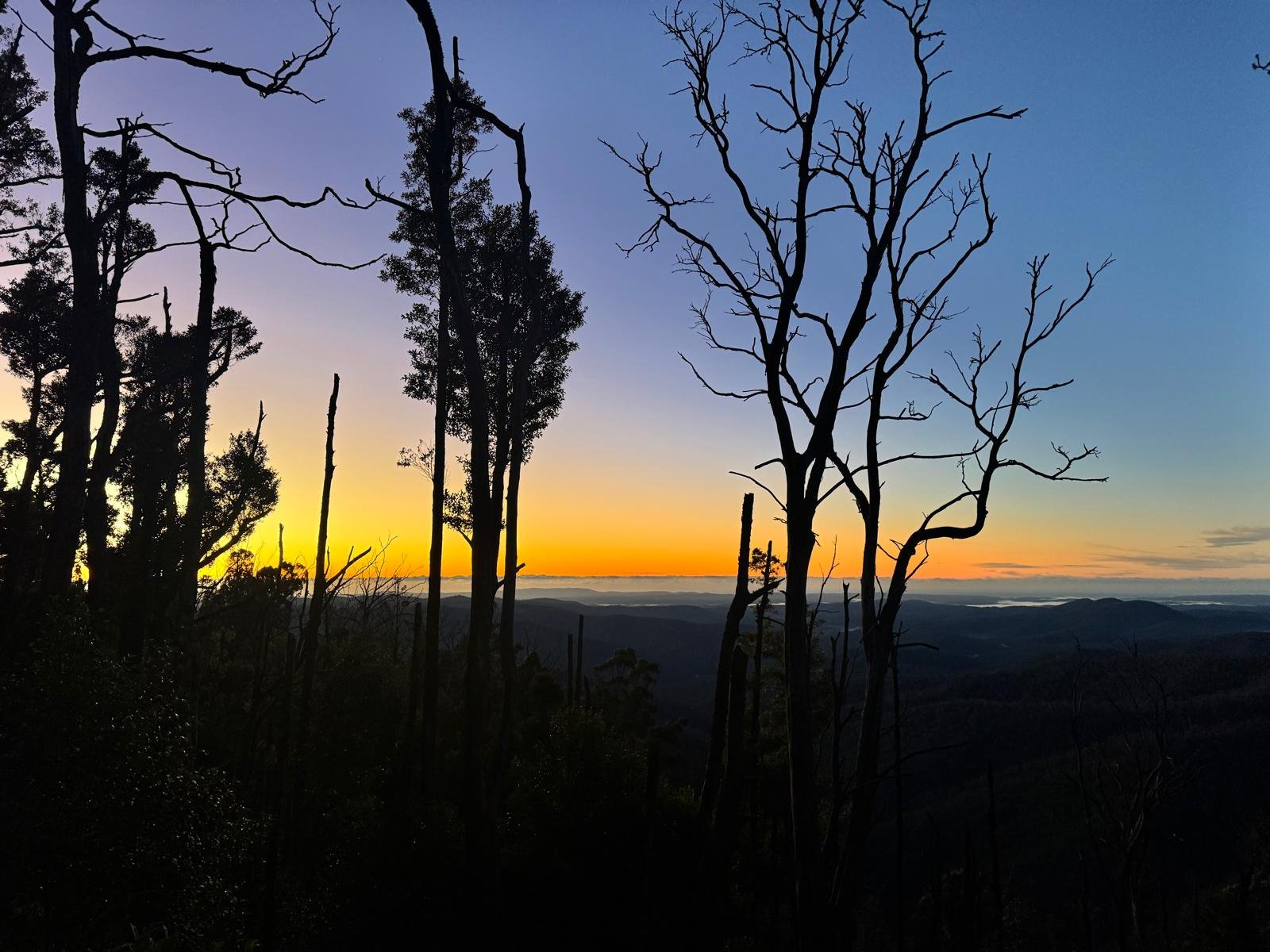
The sunrise on my last day at Plumwood Mountain (photo courtesy of Le-Anne Bannon, 2026).
Acknowledgements: Thank you to the Plumwood Committee for the opportunity to visit and work at Plumwood Mountain for three weeks as part of their short-term residency program in 2026. My writing and conceptualisation of cultivation in this reflective piece was strongly inspired by Associate Professor Jennifer Atchison’s work on ‘cultivation as resistance’ which is the subject of a forthcoming article written about research conducted with Gajerrong Country and Marralam Community in northern Australia. I was employed on this project as a Research Assistant from 2024-2026 and awarded this residency to support that work. You can find out more about the project here.